
Le Cauchemar : Vous dépensez 10 000 $ en inventaire. Vous expédiez à FBA. Vous lancez. Et puis... des grillons. Ou pire, un déluge de retours à cause d'un défaut de conception que vous n'aviez pas vu venir.
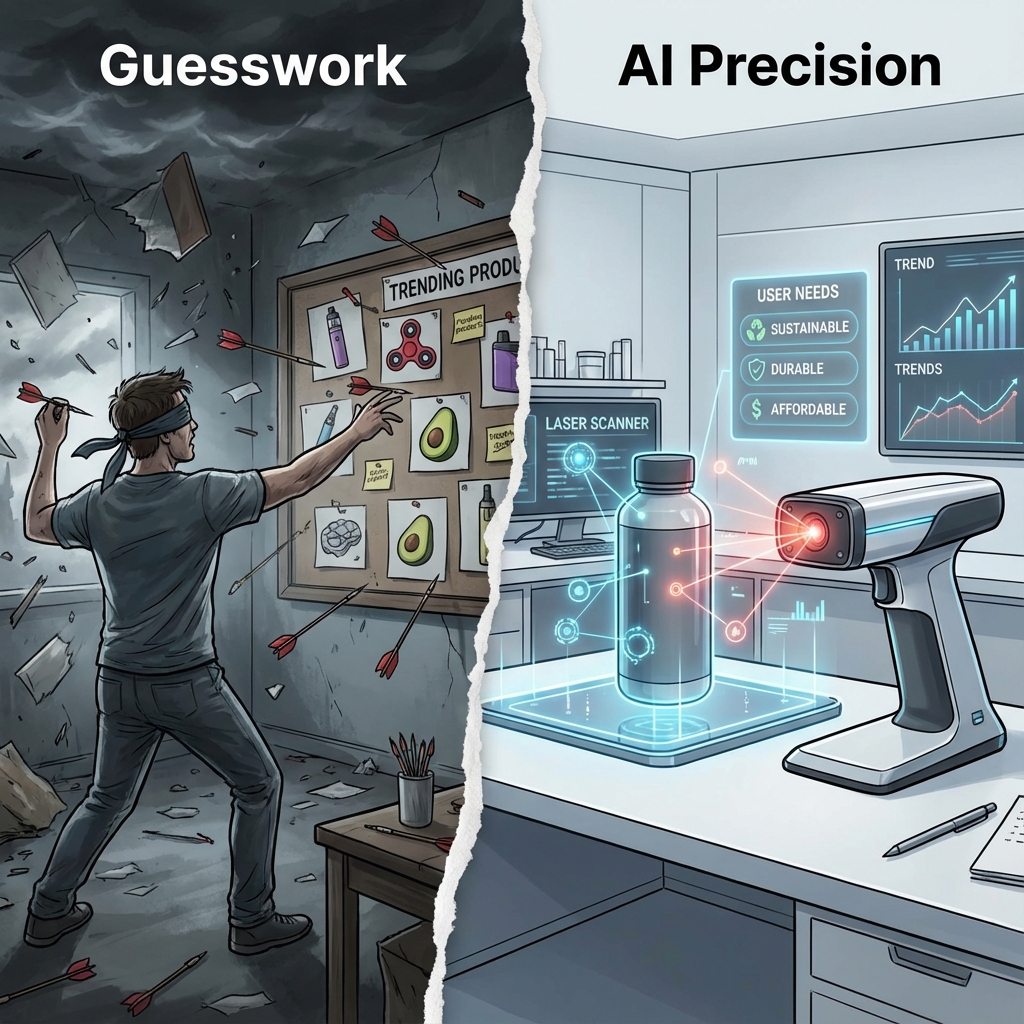
En 2025, lancer un produit en se basant sur "l'intuition" est un suicide financier.
Bienvenue dans l'ère de la "Validation Axée sur les Données". Il ne s'agit pas seulement de choisir un créneau ; il s'agit d'utiliser l'IA pour lire dans l'esprit des clients de vos concurrents et de trouver l'argent invisible sur la table.
La Logique : Extraire la Demande "Cachée"
Chaque commentaire 1 étoile sur la liste d'un concurrent est une Demande de Fonctionnalité déguisée.
Autrefois, il fallait un analyste de données pour donner un sens à 5 000 commentaires. Aujourd'hui, l'Interprète de Code ChatGPT le fait en 45 secondes.
Le Plan de Validation en 3 Étapes
Étape 1 : Extraire les Données "Secrètes"
Vous avez besoin de données brutes. Rendez-vous chez vos 5 principaux concurrents sur Amazon.
- Outils : Helium 10, Jungle Scout ou Shulex VOC.
- Action : Téléchargez leurs journaux de commentaires (CSV).
- Crucial : Filtrez uniquement pour les "Achats Vérifiés". Nous ne nous soucions que des clients payants.
Étape 2 : L'Analyse Approfondie (Analyse ChatGPT)
C'est là que vous repérez l'or. Téléchargez ce CSV sur ChatGPT (GPT-4) et utilisez cette invite exacte.
L'Invite en Or :
"Je suis chef de produit. Analysez cet ensemble de données de commentaires vérifiés.
- Regroupez les points faibles : Regroupez tous les commentaires négatifs (1 à 3 étoiles) par signification sémantique. Quelles sont les 5 principales plaintes récurrentes ? (par exemple, "La batterie se décharge rapidement", "Difficile à nettoyer").
- Scénarios d'utilisation : Analysez les commentaires positifs pour trouver exactement comment et où les gens utilisent ce produit. L'utilisent-ils d'une manière que le fabricant n'avait pas prévue ?
- L'opportunité : Sur la base de ce qui précède, suggérez 3 améliorations spécifiques du produit qui résoudraient ces principales plaintes."
Ce que vous pourriez trouver :
- Concurrent : Un aspirateur de voiture générique.
- Information de l'IA : "40 % des utilisateurs se plaignent que le cordon est trop court pour le coffre, et 30 % sont des mamans qui l'achètent pour nettoyer les miettes des sièges bébé."
- Votre produit : Un aspirateur sans fil commercialisé spécifiquement pour les "Sièges auto et coffres", avec un embout spécial pour les miettes. Gagnant instantané.
Étape 3 : Radar de Sentiment (Shulex/Voc.ai)
Si vous voulez un tableau de bord dédié, des outils comme Shulex sont dingues.
Vérifiez le graphique de la Tendance du Sentiment.
- La plainte "Fuite" a-t-elle une tendance À LA HAUSSE ?
- Feu vert : Le concurrent ignore le problème. Si vous le corrigez, le marché est à vous.
- La plainte a-t-elle une tendance À LA BAISSE ?
- Feu rouge : Ils l'ont probablement corrigé dans le dernier lot. Passez à autre chose.
Le Boss Final : Le Test de la "Fausse Porte"
Vous avez un concept gagnant. Ne le fabriquez pas encore.
- Utilisez Midjourney pour rendre votre "Produit Parfait" (en utilisant le flux de travail de mon dernier article).
- Mettez en place une simple Page de Destination Shopify.
- Dépensez 50 $ en publicités Facebook.
- Suivez les clics "Ajouter au Panier".
Si les gens essaient d'acheter un produit qui n'existe pas encore, vous avez une preuve mathématique de la demande. Remboursez-les, excusez-vous et passez votre commande à l'usine en toute confiance.
Résumé
Les amateurs jouent. Les pros calculent.
Cette boucle [Extraire -> Analyser -> Améliorer -> Vérifier] transforme le développement de produits d'une loterie en une science. Arrêtez d'écouter votre instinct. Écoutez les données.